
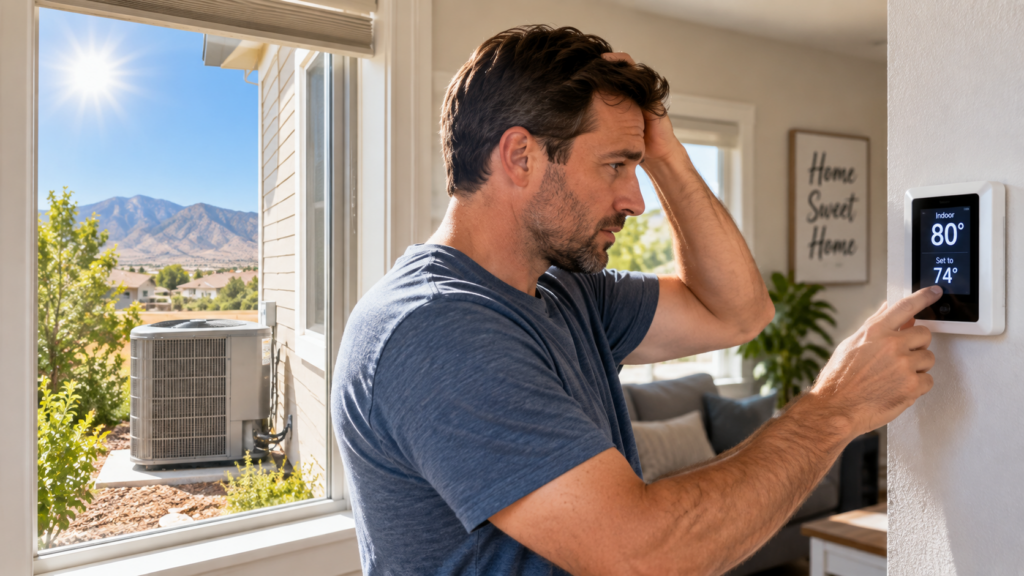
If your air conditioner keeps running during a hot Utah summer, it doesn’t necessarily mean something is wrong. On especially hot days, longer cooling cycles can be normal. But if your AC runs continuously and your home still can’t reach the temperature set on the thermostat, there may be a problem worth investigating.
An air conditioner that keeps running can be caused by something as simple as an incorrect thermostat setting or dirty air filter. It can also point to restricted airflow, dirty equipment, a frozen evaporator coil, low refrigerant, improper system sizing, or another issue that requires professional diagnosis.
The key is paying attention to more than how long the AC runs. Is your home actually getting cooler?
Is It Normal for an Air Conditioner to Keep Running When It’s Hot?
Sometimes.
Air conditioners don’t operate according to a universal schedule. How long your system runs depends on factors including the outdoor temperature, thermostat setting, insulation, home size, equipment design, system condition, and the amount of heat entering your home.
During a particularly hot Utah afternoon, your air conditioner may run much longer than it does during milder weather. Some modern variable-speed systems are also designed to operate for longer periods at lower output.
So a long cooling cycle doesn’t automatically mean something is wrong.
A more important warning sign is when your air conditioner keeps running without reaching the temperature set on the thermostat.
For example, if your thermostat is set to 74°F, your AC has been running for hours, and the indoor temperature remains at 80°F, the system may be struggling to remove enough heat from your home.
Here are some of the most common reasons that can happen.
1. Check Your Thermostat Settings First
Before assuming you have a major HVAC failure, start with the thermostat.
Make sure the thermostat is set to Cool and that the desired temperature is reasonable for current conditions.
Then check the fan setting.
If the fan is set to On, the indoor blower may continue operating even when the air conditioner isn’t actively cooling. That can make it sound and feel like your AC is running constantly.
Setting the fan to Auto generally allows the blower to cycle with the cooling system instead.
A malfunctioning thermostat can also contribute to an air conditioner that won’t shut off. Faulty sensors, wiring problems, poor thermostat placement, or an aging thermostat can prevent the system from accurately responding to the home’s temperature.
2. A Dirty HVAC Filter Can Restrict Airflow
This is one of the easiest things homeowners can check themselves.
Your HVAC filter collects dust and airborne particles as air moves through the system. As that filter becomes clogged, airflow can become restricted.
When your air conditioner can’t move enough air through the system, it may have to work longer to cool your home. Severe airflow restriction can also contribute to other HVAC problems, including a frozen evaporator coil.
Remove your filter and inspect it.
If it is visibly dirty or clogged, replace it with the appropriate filter for your system.
How frequently a filter needs to be replaced depends on the type of filter, HVAC system, household conditions, pets, dust, and other factors. Rather than relying only on the calendar, checking the filter regularly is a good habit.
If you recently changed the filter and your air conditioner keeps running, continue checking for other possible causes.
3. Check for Debris Around the Outdoor AC Unit
Your outdoor condenser needs adequate airflow too.
The condenser helps release heat that your air-conditioning system has removed from inside your home. Leaves, weeds, grass clippings, dirt, and other debris around the outdoor unit can interfere with airflow.
Take a look around your condenser.
Make sure it isn’t surrounded by vegetation or covered with obvious debris. Don’t place objects against the unit, and be careful not to damage the condenser fins while inspecting the area.
There’s an important difference between clearing leaves or vegetation from around the equipment and attempting to service the equipment yourself.
If the condenser needs internal cleaning or repair, an HVAC professional can handle that safely.
4. Your AC May Be Running but Not Cooling
This is one of the most important distinctions to make.
Ask yourself:
Is the air conditioner running for long periods but still keeping my house comfortable?
Or:
Is the air conditioner running constantly while the house keeps getting warmer?
The second situation is much more concerning.
If air coming from the vents doesn’t feel appropriately cool, airflow is weak, or the indoor temperature continues climbing while the system runs, your AC may have a problem that isn’t going to be solved by simply lowering the thermostat.
Turning the thermostat from 74°F down to 65°F won’t correct an underlying mechanical or airflow problem.
Instead, check the basic items you can safely inspect and consider calling an HVAC professional if the system still isn’t cooling properly.
5. The Evaporator Coil Could Be Frozen
It sounds strange, but an air conditioner can actually freeze during the middle of summer.
The evaporator coil inside your HVAC system needs proper airflow and operating conditions to absorb heat effectively.
Restricted airflow or certain mechanical or refrigerant problems can contribute to ice forming on the coil.
Possible warning signs include:
- Weak airflow from the vents
- AC running without adequately cooling
- Visible ice on accessible refrigerant lines or HVAC components
- Water near the indoor HVAC equipment after ice begins melting
If you suspect the system is frozen, continuing to run it isn’t a good troubleshooting strategy.
Turn the cooling system off and contact an HVAC professional if you’re unsure what’s causing the problem.
6. Low Refrigerant Can Cause Longer AC Run Times
Refrigerant plays a critical role in moving heat from inside your home to the outdoors.
An air-conditioning system isn’t supposed to routinely “use up” refrigerant like a car uses gasoline. If the system has insufficient refrigerant, there may be a leak or another issue requiring professional attention.
Low refrigerant can result in poor cooling performance, longer run times, or other abnormal operation.
Refrigerant-related problems aren’t a DIY repair. They should be diagnosed and handled by a qualified HVAC professional.
7. Your Air Conditioner May Be Improperly Sized
Bigger isn’t always better when it comes to HVAC equipment—and neither is smaller.
An air conditioner needs to be appropriately sized for the home’s cooling requirements.
If a system is undersized, it may struggle to keep up with cooling demand during hot weather and run for extremely long periods while trying to reach the thermostat setting.
Proper HVAC sizing involves more than simply looking at a home’s square footage. Insulation, windows, construction, ceiling height, orientation, and other characteristics can affect the home’s cooling load.
If your air conditioner has struggled to keep the house comfortable since it was installed, improper sizing is one possibility an HVAC professional can evaluate.
8. Your Home May Be Gaining Heat Faster Than Expected
Sometimes the air conditioner isn’t the only part of the equation.
Your home itself affects how hard the cooling system has to work.
Poor insulation, air leaks, direct afternoon sunlight, frequently opened exterior doors, aging windows, and other factors can increase the amount of heat entering the home.
Simple steps can sometimes help reduce the cooling load. Closing blinds or curtains on windows receiving intense afternoon sun, keeping exterior doors closed, and addressing obvious air leaks can all help.
This doesn’t mean every continuously running AC is caused by poor insulation. Your home and HVAC system work together, however, so both can affect cooling performance.
9. An Electrical or Mechanical Component May Be Failing
Air-conditioning systems contain numerous electrical and mechanical components.
Problems with controls, relays, contactors, motors, sensors, compressors, and other components can sometimes cause abnormal operation—including a system that doesn’t shut off when it should.
These aren’t components homeowners should attempt to diagnose by taking equipment apart.
If you’ve checked the thermostat and filter, the outdoor unit has adequate clearance, and your air conditioner keeps running without properly cooling your home, it’s time for professional diagnosis.
What Should You Check Before Calling an HVAC Technician?
If your air conditioner keeps running, there are several simple observations you can make without disassembling your HVAC system.
Check the thermostat.
Make sure it’s set to Cool and the fan isn’t accidentally set to run continuously.
Check the air filter.
Replace it if it’s visibly dirty or clogged.
Look at the outdoor unit.
Check for obvious leaves, weeds, or other debris blocking airflow around the equipment.
Compare the indoor temperature to the thermostat setting.
A significant difference can tell you that the system is struggling to reach the desired temperature.
Feel the airflow.
Is air moving normally from the vents? Does it feel cool?
Look and listen for warning signs.
Ice, unusual noises, leaking water, burning smells, or other abnormal symptoms are reasons to stop troubleshooting and contact a professional.
These observations can also give an HVAC technician useful information when you call.
When Should You Call an HVAC Professional?
Consider professional service if your air conditioner keeps running and:
- Your home isn’t reaching the thermostat setting
- The air coming from the vents isn’t cool
- Airflow is unusually weak
- You see ice on the system
- The system is leaking
- You hear unusual noises
- You notice unusual electrical or burning odors
- Changing a dirty filter doesn’t improve performance
- The system’s behavior suddenly changes
An HVAC technician can measure temperatures, airflow, refrigerant conditions, electrical performance, and other factors that can’t be accurately diagnosed simply by looking at the thermostat.
Does a Home Warranty Cover an Air Conditioner That Keeps Running?
Potentially—but the fact that an air conditioner keeps running doesn’t by itself determine whether a repair is covered.
A home warranty is a service contract that may help with the repair or replacement of covered home systems and appliances when they experience covered failures, subject to the specific contract’s terms, coverage limits, exclusions, and other conditions.
The important step is determining why the air conditioner is running continuously.
For example, a covered mechanical component failure is different from routine maintenance, a dirty filter, or another condition excluded under a warranty contract.
SilverBack Home Warranty is a Utah-based home warranty company offering plans that include coverage options for major home systems and appliances, including HVAC systems. When a covered homeowner experiences an AC problem, diagnosing the cause of the failure helps determine whether the needed repair qualifies for coverage under the homeowner’s specific plan.
Always refer to your current SilverBack Home Warranty contract for complete coverage details, limitations, exclusions, and applicable service call fees.
Why Preventive HVAC Maintenance Matters
Waiting until your air conditioner completely stops working isn’t the best way to care for the system.
Simple homeowner maintenance can help your HVAC equipment operate under better conditions.
That includes regularly checking the air filter, keeping the outdoor unit free of obvious debris, paying attention to changes in cooling performance, and addressing unusual behavior before it becomes a bigger problem.
Your AC doesn’t need to fail completely to tell you something may be wrong.
An air conditioner that suddenly starts running much longer than normal may be giving you an early warning.
Frequently Asked Questions About an Air Conditioner That Keeps Running
Why does my air conditioner keep running?
An air conditioner can keep running because of extreme outdoor heat, thermostat settings or problems, a dirty filter, restricted airflow, dirty or blocked equipment, a frozen coil, low refrigerant, improper system sizing, or mechanical or electrical problems.
Is it normal for my AC to run all day when it’s extremely hot?
Longer run times can be normal during very hot weather, especially when the outdoor temperature creates a heavy cooling load. Some variable-speed systems are also designed for longer operation. The more concerning situation is an AC that runs continuously without reaching the thermostat setting or adequately cooling your home.
Can a dirty air filter cause my AC to run continuously?
Yes. A clogged filter can restrict airflow, making it harder for the system to cool your home effectively. Severe airflow restriction can also contribute to problems such as a frozen evaporator coil.
Why is my AC running but not cooling the house?
Possible causes include an incorrect thermostat setting, restricted airflow from a dirty filter, a blocked or dirty outdoor condenser, a frozen evaporator coil, low refrigerant, or another mechanical problem. If basic checks don’t solve the problem, have the system professionally diagnosed.
Should I turn my thermostat lower if my AC can’t keep up?
Lowering the thermostat substantially won’t correct an underlying HVAC problem. If the system runs continuously but can’t reach a reasonable set temperature, check simple issues such as a dirty filter or incorrect thermostat settings and contact an HVAC professional if the problem continues.
Does a home warranty cover AC repairs?
A home warranty may cover certain HVAC repairs when the cause of the failure and needed repair meet the terms of the contract. Coverage depends on the specific plan and may be subject to coverage limits, exclusions, service call fees, and other contract provisions.
The diagnosis—not simply the symptom that the air conditioner keeps running—helps determine whether a particular repair qualifies for coverage.
Air Conditioner Keeps Running? Pay Attention to What Your Home Is Telling You
Utah summers can put significant demand on an air-conditioning system, and a long cooling cycle isn’t automatically a reason for concern.
But you know how your home normally feels.
If your air conditioner keeps running, your home isn’t getting cooler, or you’ve noticed a sudden change in the way your system operates, don’t ignore it.
Start with the basics: check the thermostat, inspect the filter, look for blocked airflow around the outdoor unit, and pay attention to what the system is doing.
Sometimes the solution is simple. When it isn’t, identifying the problem early can help you address it before you’re left without cooling on a hot Utah summer day.
For homeowners who want additional protection against unexpected covered breakdowns, SilverBack Home Warranty offers home warranty plans for major home systems and appliances.
SilverBack Home Warranty — We’ve got your back.