
Garbage Disposal Not Working? Easy Checks Before You Call for Repair
If your garbage disposal is not working, don’t assume the unit needs to be replaced right away.
A disposal can stop working because of something as simple as a tripped overload protector, loss of power, a jam, or a clogged drain. Some of those problems can be checked safely by a homeowner.
Others require professional repair.
The first thing to figure out is what the disposal is actually doing.
Is it completely silent?
Does it hum but not spin?
Does it run but fail to drain?
Is it making an unusual grinding or rattling noise?
Those symptoms can point you in different directions.
First: Be Safe Around a Garbage Disposal
Before troubleshooting anything, remember one rule:
Never put your hand inside a garbage disposal.
Even if the switch is off.
If you need to inspect the grind chamber, use a flashlight. If a visible object needs to be removed, use appropriate tools such as tongs or pliers after the disposal is safely turned off and disconnected from power when possible.
InSinkErator specifically warns homeowners not to place a hand inside the disposal while troubleshooting jams or unusual noises.
Garbage disposals combine electricity, moving components, and water.
That makes safe troubleshooting especially important.
Why Is My Garbage Disposal Not Working?
A garbage disposal can stop operating for several reasons, including:
- A tripped reset or overload protector
- A tripped circuit breaker
- A tripped GFCI outlet
- A disconnected power cord
- A jammed grinding mechanism
- A clogged drain
- A failed wall switch
- A failed motor
- Another electrical or mechanical problem
The sound the disposal makes—or doesn’t make—can help narrow things down.
1. If the Disposal Is Completely Silent, Check for Power
If you flip the switch and nothing happens at all, start with the electrical supply.
Depending on how your disposal is installed, it may plug into an outlet beneath the sink or be hardwired into the home’s electrical system.
Check:
- Whether the plug has come loose
- Whether the circuit breaker has tripped
- Whether a nearby GFCI outlet has tripped
- Whether other devices on the circuit still have power
InSinkErator recommends checking the breaker or fuse when a disposal will not turn on. For plug-in models, it also suggests checking whether the outlet itself has power.
If a breaker or GFCI repeatedly trips after being reset, stop there.
Repeated electrical trips can indicate a problem that should be evaluated rather than continually reset.
2. Check the Garbage Disposal Reset Button
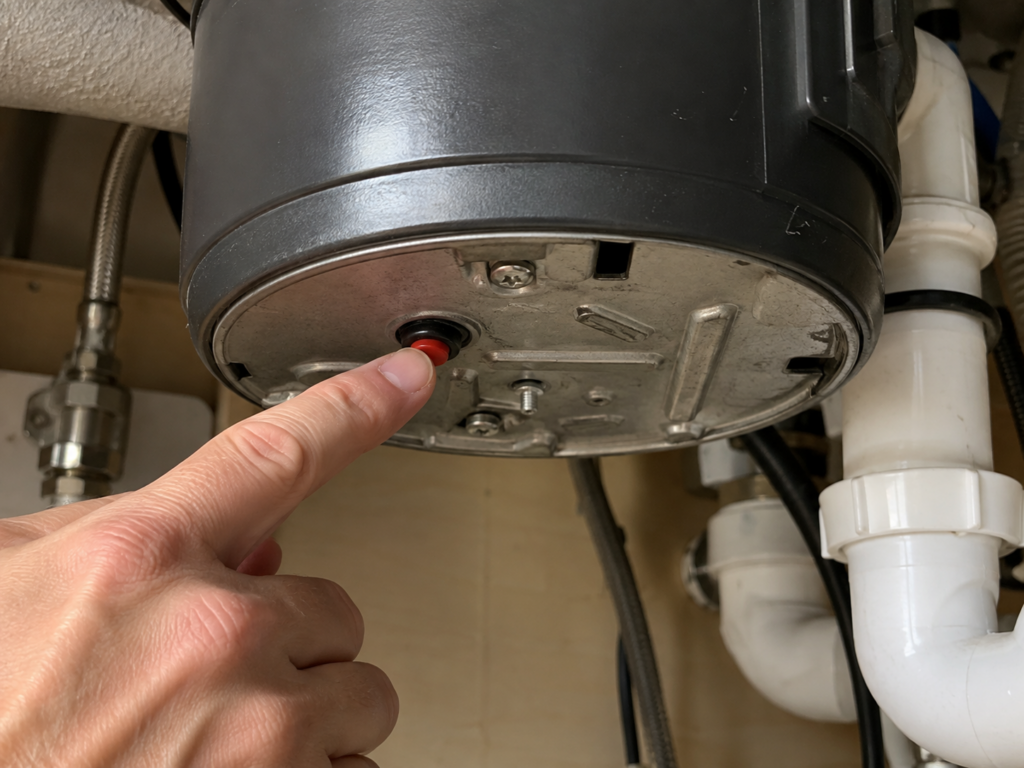
Many garbage disposals include an overload protector, commonly called the reset button.
Its job is to shut the disposal off when the motor is overloaded, jammed, or running under conditions that could cause damage.
On many InSinkErator models, the reset button is located on the bottom of the disposal underneath the sink.
Before checking it:
- Turn the disposal switch off.
- Make sure the unit is not running.
- Locate the reset button on the bottom of the disposal.
- If it has popped out, press it gently.
Some models may need time to cool before the reset will stay engaged.
InSinkErator notes that its overload protector may trip if the disposal is jammed, has been running too long, or experiences another problem.
If the disposal resets and begins working normally, you may have solved the immediate problem.
If it trips again, don’t keep pressing the button repeatedly.
Something may still be wrong.
3. If the Disposal Hums but Doesn’t Grind, It May Be Jammed
A humming sound is an important clue.
It often means the motor is receiving power but the grinding mechanism isn’t turning.
That can happen when something becomes lodged inside the disposal.
Common items that can cause trouble include:
- Bones
- Fruit pits
- Hard food scraps
- Utensils
- Bottle caps
- Glass fragments
- Other foreign objects
If the disposal hums but does not turn, switch it off immediately.
Do not let it continue humming for a long period.
That can overheat the motor and trip the overload protector.
How Do You Safely Clear a Jam?
Many garbage disposals include a place on the bottom of the unit for a disposal wrench or appropriately sized Allen wrench.
InSinkErator’s current troubleshooting instructions recommend turning the disposal off, then using the manufacturer-provided jam wrench or a compatible 1/4-inch Allen wrench on applicable models to work the mechanism back and forth until it moves freely.
The exact procedure depends on the model, so check your owner’s manual.
If you can see an object inside the disposal, use tongs or pliers rather than your hand.
If the disposal remains jammed after basic manufacturer-approved troubleshooting, call a professional.
4. Check for a Tripped GFCI Outlet
Garbage disposals are often located in kitchens, where GFCI protection may be present.
If your disposal suddenly loses power, check nearby GFCI outlets.
The outlet controlling the disposal may not necessarily be directly beneath the sink.
A GFCI located elsewhere in the kitchen could protect downstream outlets.
If you find a tripped GFCI:
- Make sure the disposal switch is off.
- Reset the GFCI.
- Test the disposal.
If the GFCI immediately trips again, don’t continue resetting it.
That could indicate an electrical fault in the disposal, outlet, wiring, or another device on the protected circuit.
5. What If the Disposal Runs but the Sink Won’t Drain?
If the disposal motor runs but water remains in the sink, the problem may be more related to drainage than the disposal motor itself.
Possible causes include:
- Food buildup
- A clogged drain line
- A blockage in the disposal
- A clog farther downstream
InSinkErator distinguishes between a jammed disposal and a clogged drain. Its guidance notes that a disposal can be running while the sink still fails to drain because of a drain blockage.
If water is standing in the sink, avoid repeatedly running the disposal hoping the clog will disappear.
That may not solve the underlying drainage problem.
6. Listen for Unusual Noises
A garbage disposal normally makes noise while operating.
But a new rattling, metallic, clanking, or grinding sound can indicate that something is inside the grind chamber that shouldn’t be there.
If you hear an unusual noise:
- Turn the disposal off
- Disconnect power if appropriate
- Use a flashlight to inspect the opening
- Look for visible foreign objects
If you see something like a utensil, cap, or other object, use tongs or pliers to remove it safely.
InSinkErator recommends this approach for unusual disposal noises and again warns against placing your hand inside the unit.
If you can’t identify the cause, have the disposal inspected.
7. The Disposal May Have a Motor or Electrical Failure
If you have confirmed that:
- The breaker is on
- The GFCI is reset
- The unit has power
- The reset button is not tripped
- The disposal isn’t obviously jammed
and the unit still does not operate correctly, there may be an internal electrical or mechanical failure.
Possible problems can involve:
- Motor components
- Internal wiring
- Switches
- Bearings
- Internal electrical controls
- Other mechanical components
That is where homeowner troubleshooting should generally stop.
What Should You Check Before Calling for Repair?
If your garbage disposal is not working, these are reasonable first steps:
Turn the disposal off.
Always start safely.
Check the breaker.
Make sure the circuit has power.
Check nearby GFCI outlets.
Reset a tripped GFCI once if appropriate.
Check the reset button.
If the overload protector has tripped, allow the unit to cool and follow the manufacturer’s reset instructions.
Listen to the sound.
Silence and humming can suggest very different problems.
Look for visible objects.
Use a flashlight, not your hand.
Check whether the sink drains.
A drain clog may be separate from a disposal motor problem.
If those checks don’t identify the problem, professional service makes sense.
What Should You Never Put Down a Garbage Disposal?
Proper use can help reduce jams and clogs.
Avoid putting obvious non-food items into the disposal.
Depending on the manufacturer and plumbing setup, it’s also wise to be careful with materials that can cause clogs, jams, or buildup.
Common troublemakers can include:
- Grease and fats
- Large bones
- Hard pits
- Non-food items
- Utensils
- Glass
- Excessive amounts of food at once
InSinkErator specifically advises against pouring grease or fat down the disposal or drain.
Follow the recommendations for your particular model.
Should You Use Hot or Cold Water With a Garbage Disposal?
Many manufacturers recommend using cold water while grinding food waste.
InSinkErator recommends running a moderate flow of cold water while the disposal is operating and continuing the water briefly after grinding is complete.
Cold water can help keep fats more solid while they move through the system rather than allowing them to coat plumbing.
Always check your disposal’s owner’s manual for model-specific instructions.
Can a Garbage Disposal Overheat?
Yes.
A jammed or overloaded disposal may cause the motor’s overload protector to trip.
This is one reason you should turn the disposal off if it is humming but not rotating.
Continuing to energize a jammed motor can create additional heat.
If the reset button will not stay engaged, the unit may need more time to cool—or there may still be a problem that needs attention.
When Should You Call a Plumber or Appliance Professional?
Consider calling a professional if:
- The disposal repeatedly trips the reset button
- The circuit breaker or GFCI repeatedly trips
- The disposal hums but remains jammed
- You cannot safely remove a foreign object
- The unit leaks
- You hear unusual internal noises
- The disposal has power but will not run
- The sink remains clogged after basic troubleshooting
- You smell burning
- There are signs of an electrical problem
Stop troubleshooting immediately if you see exposed wiring, sparking, smoke, or signs of overheating.
Is a Leaking Garbage Disposal Repairable?
Sometimes.
Where the water is coming from matters.
A leak may originate from:
- The sink mounting connection
- The dishwasher connection
- The discharge pipe
- Plumbing fittings
- The disposal housing itself
Some connection leaks may involve plumbing repairs.
A leak from the body of the disposal itself can indicate internal failure and may require replacement.
Professional diagnosis can determine the source before you decide what to repair.
Does a Home Warranty Cover a Garbage Disposal?
Potentially.
A home warranty may cover certain garbage disposal failures when the disposal is included in the homeowner’s plan and the cause of failure meets the contract terms.
As with other home warranty claims, the symptom alone doesn’t determine coverage.
“Garbage disposal not working” tells us what the homeowner sees.
A diagnosis identifies what actually failed.
SilverBack Home Warranty offers plan options that include coverage for certain home systems and appliances, subject to applicable limits, exclusions, service call fees, and contract terms.
Always review your current SilverBack Home Warranty contract for exact coverage details.
Frequently Asked Questions About a Garbage Disposal Not Working
Why is my garbage disposal not working?
Possible causes include a tripped reset button, tripped breaker or GFCI, jam, clogged drain, electrical problem, or failed disposal motor.
Where is the garbage disposal reset button?
On many models, the reset or overload protector is located on the bottom of the disposal beneath the sink. Check your owner’s manual because design varies by manufacturer.
Why does my garbage disposal hum but not spin?
A humming disposal often indicates that the motor has power but the grinding mechanism is jammed. Turn it off promptly and follow the manufacturer’s jam-clearing instructions.
Should I put my hand inside the disposal to remove something?
No.
Never place your hand inside the garbage disposal. Use a flashlight and appropriate tools such as tongs or pliers after the disposal is safely turned off and disconnected from power when applicable.
Why does the reset button keep popping out?
The overload protector can trip when the unit is jammed, overloaded, overheated, or experiencing another problem. Repeated trips mean the underlying cause should be investigated.
Why is my disposal running but the sink won’t drain?
The disposal may be operating correctly while the drain line itself is clogged. A drainage problem can require different troubleshooting than a disposal that won’t run.
Does a home warranty cover garbage disposal repair?
It may, depending on the homeowner’s plan, the failed component, cause of failure, contract limits, and exclusions. Diagnosis is usually needed before coverage can be determined.
Garbage Disposal Not Working? Start With the Simple Checks
A garbage disposal not working doesn’t always mean the unit has reached the end of its life.
Start with the basics.
Check the breaker.
Check the GFCI.
Look at the reset button.
Listen for humming.
Check for a visible obstruction using a flashlight.
And never place your hand inside the disposal.
If those steps don’t solve the problem—or if you see signs of electrical failure, leaking, or repeated overloads—have the unit professionally inspected.
Sometimes the fix is simple.
Sometimes the disposal is telling you it needs more than a reset.
SilverBack Home Warranty — We’ve got your back.