
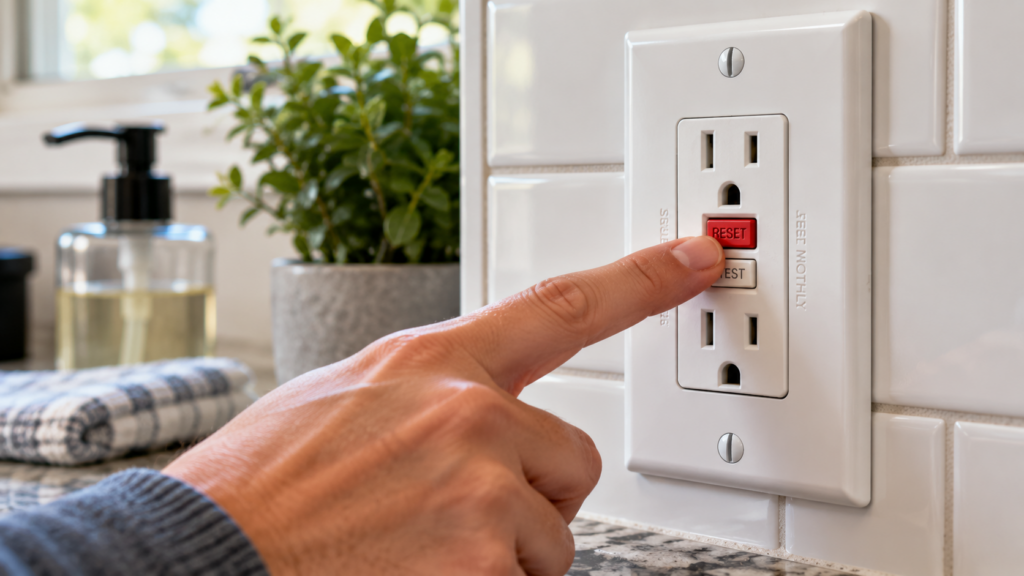
A GFCI outlet can keep tripping for several reasons, including:
- A faulty appliance or electrical device
- Moisture around an outlet or connected equipment
- Damaged cords or plugs
- A problem somewhere else on the protected circuit
- A deteriorating GFCI receptacle
- An electrical wiring problem
- An actual ground fault
Sometimes the cause is easy to identify.
Other times, repeated tripping is the only obvious warning that something isn’t right.
1. A Plugged-In Appliance May Be Causing the Trip
One of the first things to consider is what was plugged in when the GFCI tripped.
Common household appliances used around GFCI outlets may include:
- Hair dryers
- Curling irons
- Toasters
- Coffee makers
- Blenders
- Power tools
- Outdoor equipment
- Small kitchen appliances
If the GFCI trips when you turn on one particular appliance, unplug that appliance before resetting the outlet.
Then pay attention to what happens.
If the GFCI resets normally and remains on after the appliance is removed, the appliance or its cord may be involved.
Don’t continue repeatedly plugging in a device that causes the outlet to trip. A damaged appliance, cord, or plug should be inspected or repaired rather than repeatedly overriding the warning.
2. Moisture Can Cause a GFCI to Trip
GFCI protection is commonly used in locations where water may be present, so moisture is another possible cause.
Outdoor outlets can be exposed to rain, snow, irrigation, condensation, or other moisture.
Indoor locations can have moisture problems too.
Think about areas around:
- Kitchen sinks
- Bathroom sinks
- Showers
- Laundry equipment
- Utility rooms
- Garages
- Basements
If water has entered an electrical outlet, enclosure, appliance, extension cord, or connected equipment, don’t keep resetting the GFCI simply to see if it will stay on.
Allowing electrical equipment to dry and determining where the moisture came from may be necessary, and an electrician should evaluate situations where water has entered electrical components or you aren’t certain the area is safe.
3. A Damaged Cord or Plug Could Be the Problem
Take a look at the devices that were connected when the outlet tripped.
You don’t need to take anything apart.
Simply inspect the visible cord and plug.
Warning signs can include:
- Frayed insulation
- Cuts in a cord
- Bent or damaged plug blades
- Cracked plugs
- Burn marks
- Melted areas
- Loose connections where the cord meets the appliance
If something looks damaged, unplug it and stop using it until it can be repaired or replaced.
A GFCI that trips when a particular damaged appliance is connected may be warning you about a real electrical problem.
4. The Problem May Be at Another Outlet
Here’s something homeowners don’t always realize:
The GFCI outlet that trips isn’t necessarily the only outlet it protects.
One GFCI receptacle can sometimes provide protection to additional outlets farther downstream on the same circuit.
That means something plugged into another receptacle may cause the GFCI to trip.
This is also why you might discover a bathroom, garage, kitchen, basement, or outdoor outlet with no power even though the outlet itself doesn’t have TEST and RESET buttons.
A different GFCI elsewhere may have tripped.
If several outlets suddenly stop working, look for nearby GFCI outlets and check whether one needs to be reset.
5. Too Many Devices May Point to a Different Electrical Problem
People sometimes assume that every GFCI trip means the circuit is overloaded.
That isn’t necessarily the case.
A GFCI responds to ground-fault conditions, while the circuit breaker is generally responsible for protecting against excessive current.
However, when multiple devices are operating at the same time, you could have more than one electrical issue to consider.
If both a breaker and GFCI are repeatedly tripping, or you’re unsure which device is interrupting power, an electrician can identify what’s actually happening.
Repeated electrical trips should not simply be treated as an inconvenience.
6. The GFCI Outlet Itself Can Eventually Fail
Electrical devices don’t last forever.
GFCI receptacles contain internal components that can eventually fail or lose their ability to provide protection.
Modern GFCIs commonly include self-testing features, but homeowners should still pay attention to the device’s status indicators and operation.
A GFCI may need professional attention or replacement if:
- It won’t reset
- It won’t trip when tested
- It repeatedly trips for no identifiable reason
- An indicator light shows a fault
- The outlet feels loose or damaged
- You see discoloration or signs of overheating
Don’t assume a GFCI is protecting you simply because it still looks normal from the outside.
Why Won’t My GFCI Outlet Reset?
This is another common homeowner question.
If you press RESET and nothing happens, several possibilities exist.
The Circuit May Not Have Power
Some GFCI receptacles cannot reset when power isn’t reaching them.
Check whether a circuit breaker has tripped.
A breaker doesn’t always look obviously tripped. Depending on the electrical panel, you may need to identify the appropriate breaker and determine whether it is in the normal operating position.
If you are uncomfortable working around an electrical panel, contact an electrician rather than experimenting.
Something May Still Be Causing the Ground Fault
If a connected appliance or device is creating the problem, the GFCI may trip again immediately after you reset it.
Unplug devices from the affected outlet and potentially affected downstream outlets, then try the RESET button again.
If it resets after something is unplugged, that information can help identify the source of the problem.
The GFCI May Have Failed
If the outlet has power available but won’t reset, the receptacle itself may have failed.
A GFCI that cannot provide proper protection should not simply be treated as a normal outlet.
Have it evaluated and replaced if necessary.
There Could Be a Wiring Problem
Improper wiring can also prevent a GFCI from functioning correctly.
This is particularly worth considering if the problem began after:
- A new outlet was installed
- Electrical work was performed
- The GFCI was recently replaced
- Other outlets on the circuit were modified
At that point, the solution involves electrical diagnosis rather than homeowner troubleshooting.
How Do You Reset a GFCI Outlet?
For a normal trip, resetting a GFCI is usually simple.
First, unplug any appliance you suspect may have caused the problem.
Then:
- Locate the RESET button on the GFCI.
- Press the button firmly.
- Confirm that power returns.
- Watch to see whether the outlet trips again.
Some RESET buttons require a fairly firm press.
If the outlet immediately trips again, don’t keep pressing RESET over and over.
Repeatedly resetting a GFCI without figuring out why it is tripping can hide an electrical problem that needs attention.
What Do the TEST and RESET Buttons Do?
The two buttons aren’t interchangeable.
TEST intentionally trips the GFCI. It allows you to confirm that the device can interrupt power.
RESET restores the GFCI after it has tripped, assuming the device is functioning correctly and conditions allow it to reset.
Manufacturers recommend periodically testing GFCI receptacles according to the device’s instructions.
When you press TEST, the protected outlet should lose power.
Pressing RESET should restore it.
If the GFCI doesn’t respond correctly to testing, have the device evaluated.
What Should You Do If a GFCI Keeps Tripping?
If the GFCI outlet keeps tripping, work through a few simple observations.
Think about what happened immediately before the trip.
Did you turn on a hair dryer, coffee maker, power tool, or another appliance?
Unplug connected devices.
Remove the possible source of the fault before attempting another reset.
Inspect visible cords and plugs.
Look for damage without opening electrical equipment.
Look for moisture.
Consider whether the outlet or connected equipment may have been exposed to water.
Check other outlets nearby.
A downstream device may be involved.
Try one normal reset.
If the GFCI immediately trips again, don’t continue repeatedly resetting it.
These steps can sometimes identify a simple appliance-related cause without exposing you to electrical components.
What Shouldn’t a Homeowner Do?
Electrical troubleshooting has limits.
Don’t:
- Remove the outlet from the electrical box while it is energized
- Touch exposed wiring
- Bypass the GFCI
- Replace the GFCI with a standard receptacle simply because it keeps tripping
- Continue using visibly damaged appliances or cords
- Repeatedly reset a device that immediately trips again
- Attempt electrical repairs you’re not trained or comfortable performing
GFCIs are safety devices.
A repeatedly tripping GFCI shouldn’t be treated like an annoying alarm you simply need to silence.
When Should You Call an Electrician?
Contact a qualified electrician if:
- The GFCI immediately trips every time you reset it
- The outlet won’t reset
- The TEST button doesn’t work properly
- You smell burning or see discoloration
- The outlet or wall plate feels unusually hot
- You hear buzzing or crackling
- Water has entered the outlet or electrical box
- A breaker is also repeatedly tripping
- Multiple outlets unexpectedly lose power
- You can’t determine what’s causing repeated trips
- Electrical work was recently performed and the problem began afterward
You should also stop troubleshooting if you’re simply uncomfortable with what you’re seeing.
Electrical systems aren’t a good place for guesswork.
Does a Home Warranty Cover GFCI Outlet Problems?
Potentially, depending on the cause of the problem and the terms of the home warranty contract.
A home warranty may provide coverage for certain electrical system failures when the failed item and cause of failure meet the conditions of the homeowner’s plan.
But a GFCI trip is a symptom, not a diagnosis.
For example, a failed electrical component may be different from an excluded condition, damage to a personal appliance, improper modification, or another situation outside the scope of a home warranty.
SilverBack Home Warranty offers home warranty plans with coverage options for electrical systems and other major systems and appliances.
When a homeowner files a claim, identifying the actual cause of the problem helps determine whether the repair qualifies for coverage under the specific contract.
Always refer to your current SilverBack Home Warranty contract for exact coverage, limitations, exclusions, and applicable service call fees.
Frequently Asked Questions About GFCI Outlets
Why does my GFCI outlet keep tripping?
A GFCI can repeatedly trip because of a faulty appliance, damaged cord, moisture, a ground fault somewhere on the protected circuit, a wiring problem, or a failing GFCI receptacle.
If removing connected devices doesn’t solve the problem, an electrician should investigate.
Why does my GFCI trip when I plug something in?
If the outlet consistently trips when one particular appliance is plugged in or turned on, the appliance, its cord, or another electrical condition associated with that device may be causing the GFCI to respond.
Stop using the suspected device until it has been checked.
Why won’t my GFCI reset?
A GFCI may not reset because power isn’t reaching the circuit, an electrical fault is still present, the device has failed, or there is a wiring problem.
If basic checks don’t identify the cause, have an electrician evaluate it.
Can one GFCI control other outlets?
Yes. A GFCI receptacle can be wired to provide protection to additional outlets downstream.
That’s why an ordinary-looking outlet that suddenly loses power may actually be connected to a tripped GFCI somewhere else on the circuit.
Is a GFCI supposed to be tested?
Yes. GFCI manufacturers provide a TEST button so homeowners can verify that the device properly interrupts power. Follow the manufacturer’s instructions for testing and resetting your specific receptacle.
Should I keep resetting a GFCI that trips?
No. If the outlet trips once and resets normally after an obvious temporary cause is removed, that may resolve the issue.
But if your GFCI outlet keeps tripping, immediately trips after reset, or has no obvious cause, stop repeatedly resetting it and have the electrical problem investigated.
Does a home warranty cover a GFCI outlet?
Coverage depends on the home warranty plan, the failed component, the cause of failure, and the terms and exclusions of the contract. A professional diagnosis may be needed to determine what has failed and whether the repair qualifies for coverage.
A Tripping GFCI Is Trying to Tell You Something
It’s tempting to think of a tripped outlet as an inconvenience.
But that’s not why the GFCI is there.
If your GFCI outlet keeps tripping, start with the simple possibilities: unplug connected appliances, inspect visible cords, look for moisture, and consider what was happening immediately before the trip.
If it resets and stays on after the obvious cause is removed, you’ve learned something useful.
If it won’t reset or immediately trips again, don’t keep forcing it.
That’s when it’s time to have the electrical system professionally evaluated.
For Utah homeowners who want additional protection against unexpected covered failures of major home systems and appliances, SilverBack Home Warranty offers several home warranty plan options.
SilverBack Home Warranty — We’ve got your back.