
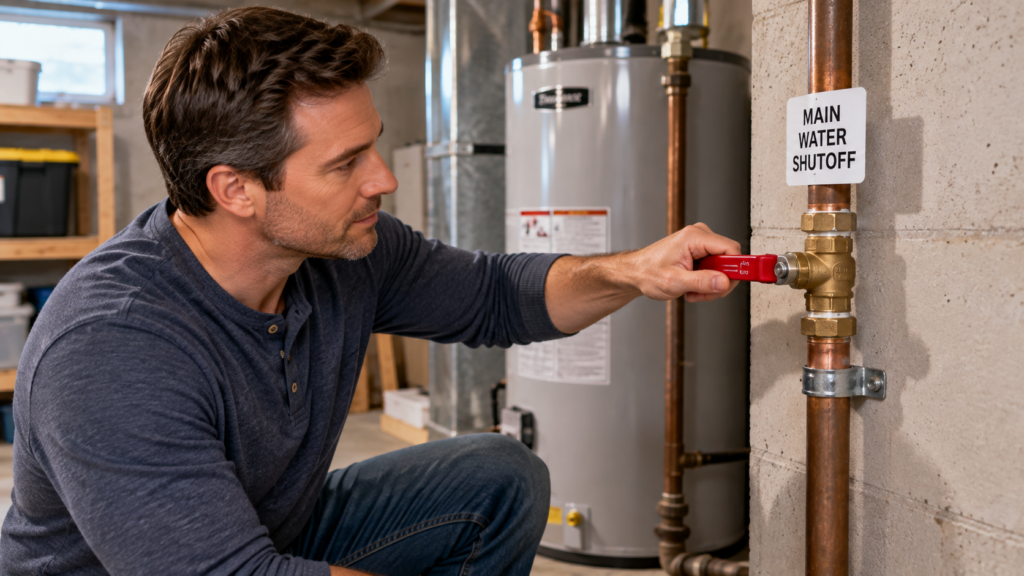
If you’re asking “where is my main water shutoff valve?”, the best time to find the answer is before water starts pouring across the floor.
Your home’s main water shutoff valve controls the water supply entering the house. In a plumbing emergency, closing that valve can help stop or dramatically reduce the flow of water while you arrange repairs.
The exact location varies from home to home, but the valve is often found near the point where the main water supply pipe enters the house. Depending on the home’s construction, that may be in a basement, utility room, crawl space, garage, mechanical room, or near an exterior wall.
Knowing where the valve is—and making sure you can operate it—is one of the simplest emergency-preparedness steps a homeowner can take.
What Does the Main Water Shutoff Valve Do?
The main water shutoff valve controls water flowing from the home’s primary water supply into the plumbing system.
Closing it can stop water from reaching most or all of the fixtures and plumbing lines inside the home.
That can be extremely useful if you experience something such as:
- A burst plumbing pipe
- A major plumbing leak
- A broken fixture supply line
- A leaking water heater
- Water spraying from damaged plumbing
- A plumbing repair that requires the home’s water supply to be turned off
The faster you can stop the water, the less opportunity it has to damage flooring, drywall, cabinets, furniture, and other parts of your home.
Where Is My Main Water Shutoff Valve Usually Located?
There isn’t one location that applies to every house.
The easiest way to start searching is to think about where the water supply enters your home from the street or well system.
The main shutoff valve is often nearby.
Basement
If your home has a basement, start there.
Look along the foundation wall facing the street or the general direction of the municipal water supply.
You may see a water pipe passing through the foundation with a valve installed shortly after it enters the house.
Mechanical or utility rooms are particularly common locations.
Utility or Mechanical Room
Homes without traditional basements may have a dedicated utility or mechanical room.
Look around:
- The water heater
- Furnace or HVAC equipment
- Water softener
- Other plumbing equipment
The valve may be installed along an exposed water line entering the room.
Crawl Space
In some homes, the main shutoff can be located in or near a crawl space.
Accessibility can vary considerably.
If reaching the valve would require crawling through a difficult or unsafe area during an emergency, it may be worth discussing better shutoff access with a plumber.
Garage
Some homes have the main water shutoff in the garage, particularly near an exterior wall or utility area.
Look for exposed plumbing entering through the wall or floor.
Near an Exterior Wall
In some climates and home designs, the shutoff may be located outside or in an exterior utility box.
Outdoor arrangements vary by location, construction, and local plumbing practices.
Be careful not to confuse your homeowner-accessible main shutoff with utility-owned equipment at or near the water meter.
Start by Looking for the Main Water Line
If you don’t immediately see a valve, look for the largest cold-water supply pipe entering the home.
The plumbing may be made from materials such as:
- Copper
- PEX
- CPVC
- Galvanized steel
- Other approved plumbing materials
Follow the incoming line.
The main shutoff valve is generally positioned so it can stop water before it continues into the rest of the home’s plumbing system.
If you’re looking at multiple valves and aren’t sure which one controls the whole house, don’t randomly start turning them.
A plumber can identify and label the correct valve for you.
What Does a Main Water Shutoff Valve Look Like?
Two common styles homeowners may encounter are gate valves and ball valves.
Gate Valve
A gate valve usually has a round wheel-shaped handle.
It may look similar to an outdoor faucet handle.
To close many gate valves, the handle is turned clockwise several rotations.
Older homes commonly have gate valves, and these valves can become difficult to operate after years without use.
Ball Valve
A ball valve usually has a straight lever handle.
Rather than turning several rotations, the lever generally moves about one-quarter turn.
When the handle is parallel to the pipe, the valve is typically open.
When the handle is turned perpendicular to the pipe, it is typically closed.
Ball valves are often easier to operate quickly than older wheel-style valves.
Gate Valve vs. Ball Valve: What’s the Difference?
The major difference for homeowners is how they operate.
A gate valve generally requires several turns of a round handle to completely open or close.
A ball valve normally requires only a quarter-turn of a lever.
Both can function as water shutoffs, but aging gate valves sometimes become stiff, corroded, or difficult to operate.
Whatever type you have, you should know how yours works before an emergency occurs.
How Do I Shut Off the Water to My House?
Once you’ve correctly identified your main shutoff valve, closing it is generally straightforward.
For a Ball Valve
Move the lever approximately one-quarter turn until it is perpendicular to the pipe.
Do not force the handle beyond its normal stopping point.
For a Gate Valve
Turn the round handle clockwise until the valve closes.
Turn it steadily and gently.
Do not apply excessive force to an old or corroded valve.
After closing the main valve, open a faucet inside the home to see whether the water pressure drops.
Some water may remain in the plumbing lines temporarily, so don’t expect every faucet to become completely dry instantly.
Don’t Force a Stuck Shutoff Valve
This is important.
If you locate the valve but discover that it won’t move, don’t grab a large wrench and force it.
Older valves can deteriorate internally.
Excessive force could damage the handle, valve stem, piping, or connections—and potentially create the plumbing emergency you were trying to prepare for.
If your main shutoff is:
- Corroded
- Leaking
- Extremely difficult to turn
- Completely stuck
- Damaged
- Located somewhere you can’t safely access
Have a plumber inspect it.
Finding out that your valve doesn’t work during a calm Saturday morning is much better than discovering it during a burst pipe at 2 a.m.
How Can I Tell If the Water Is Actually Off?
After closing the main shutoff, turn on a faucet inside the house.
Water may run briefly because there is still pressure and water inside the plumbing system.
The flow should eventually decrease significantly or stop.
If the water continues flowing normally, you may have:
- Closed the wrong valve
- Not fully closed the main valve
- A valve that isn’t functioning correctly
- A plumbing configuration that needs professional evaluation
If you’re uncertain, don’t disassemble anything.
Have a plumber confirm the setup.
When Should You Shut Off the Main Water?
A main shutoff is useful when you have a significant plumbing problem that can’t be controlled at an individual fixture.
Examples include:
A Burst Pipe
If water is spraying or rapidly escaping from plumbing inside the home, shutting off the main supply can help reduce additional water damage.
A Major Supply-Line Failure
Flexible water lines serving toilets, faucets, washing machines, or other equipment can sometimes fail.
If the individual fixture valve isn’t accessible or isn’t working, the main shutoff may be the fastest option.
A Serious Water Heater Leak
If a water heater is leaking heavily, shutting off the appropriate water supply may help control the situation.
Water heaters involve additional electrical or gas considerations, so don’t attempt repairs unless you’re qualified to do so.
Plumbing Repairs
Some plumbing work requires the household water supply to be shut off.
A plumber may use the main valve or a more localized shutoff depending on the repair.
When Don’t You Need to Shut Off the Whole House?
Many plumbing fixtures have their own individual shutoff valves.
For example, you may find local shutoffs under sinks or behind toilets.
If a toilet supply line is leaking and you can safely close the toilet’s individual shutoff valve, you may not need to turn off water to the entire home.
Localized valves allow the rest of the house to continue receiving water.
However, if the local valve doesn’t work—or you can’t quickly determine where the water is coming from—the main shutoff may be the safer option.
What Should You Do During a Major Plumbing Leak?
If significant water is escaping inside your home, your priorities should be simple.
1. Stop the water if you can do so safely.
Use the appropriate fixture shutoff or main water shutoff.
2. Be aware of electricity.
Water and electricity can create a serious hazard. Don’t step into standing water near electrical equipment, outlets, appliances, or wiring.
3. Protect the area when possible.
Move belongings away from spreading water if it is safe to do so.
4. Contact the appropriate professional.
A plumber can diagnose and repair the source of the leak.
5. Document damage when appropriate.
Photos can be useful for repair records, insurance, or other documentation.
The main objective is limiting additional damage without creating a safety risk.
Should You Test Your Main Water Shutoff Valve?
It’s a good idea to know whether your valve is accessible and operational before an emergency occurs.
That doesn’t mean repeatedly opening and closing an old valve that appears fragile or corroded.
Instead, inspect it periodically.
Ask yourself:
- Can I reach it easily?
- Do I know which valve it is?
- Is the handle damaged?
- Is there visible corrosion?
- Is the valve leaking?
- Does everyone in the household know where it is?
If you have concerns about operating the valve, have a plumber inspect it.
Label Your Main Shutoff Valve
Once you’ve identified the correct valve, consider labeling it.
A simple tag reading:
MAIN WATER SHUTOFF
can save valuable time during an emergency.
Make sure other adults in the household know:
- Where the valve is
- What it looks like
- How it operates
- When they should use it
It’s also worth showing older teenagers or anyone who regularly watches the home.
A plumbing emergency doesn’t always happen when the person who normally handles home maintenance is there.
What About the Water Meter Shutoff?
Homes connected to municipal water generally also have a shutoff associated with the water meter or service line.
That is not necessarily the same as your home’s normal main shutoff valve.
Depending on the local utility and installation, some meter valves are intended for utility or professional use.
Don’t assume you should operate a street-side or meter shutoff just because you can see it.
If your home’s main valve doesn’t work during a serious leak, contact the water utility or a licensed plumber for guidance.
Does a Home Warranty Cover Plumbing Leaks?
A home warranty may provide coverage for certain plumbing system failures when the failed component and cause of failure meet the terms of the contract.
However, the presence of water doesn’t automatically determine coverage.
The actual cause of the leak matters.
A covered plumbing component failure may be treated differently from damage caused by an excluded condition or another issue outside the home warranty agreement.
SilverBack Home Warranty offers plans with coverage options for certain plumbing systems and components.
If a homeowner experiences a plumbing problem, professional diagnosis helps determine:
- What failed
- What caused the failure
- What repair is needed
- Whether the repair qualifies for coverage
Always review the current SilverBack Home Warranty contract for specific coverage terms, limitations, exclusions, and service call fees.
Frequently Asked Questions About Main Water Shutoff Valves
Where is my main water shutoff valve?
The main water shutoff valve is commonly located near the point where the main water supply enters your home. Check basements, utility rooms, crawl spaces, garages, mechanical rooms, and areas along the foundation wall facing the street or water supply.
What does a main water shutoff valve look like?
Many homes have either a round wheel-style gate valve or a lever-style ball valve installed on the incoming water line.
Which direction turns the water off?
A gate valve is generally closed by turning the wheel clockwise.
A ball valve typically closes with a quarter-turn until the handle is perpendicular to the pipe.
Don’t force a valve that is stuck or severely corroded.
How do I know if I shut off the right valve?
After closing the valve, open a faucet inside the house. Water pressure should decrease and eventually stop or significantly reduce.
Can I shut off water to only one fixture?
Often, yes.
Toilets, sinks, and some appliances may have individual shutoff valves. Using a local valve can allow you to isolate one problem without shutting off water to the entire house.
What if my main shutoff valve won’t turn?
Don’t force it.
A stuck, corroded, or damaged main valve should be evaluated by a plumber. Forcing an aging valve can damage the valve or connected plumbing.
Should everyone in my house know where the shutoff is?
Yes.
Anyone responsible enough to respond to an emergency should know the location of the main shutoff and understand how it operates.
Does a home warranty cover a leaking pipe?
Some plumbing failures may qualify for home warranty coverage depending on the component, cause of failure, location, plan, exclusions, and other contract terms.
A professional diagnosis is usually necessary to determine whether a specific repair is covered.
Find Your Main Water Shutoff Before You Need It
A plumbing emergency isn’t the ideal time to walk through your home wondering, “where is my main water shutoff valve?”
Find it now.
Identify the pipe.
Make sure you know whether you have a gate valve or ball valve.
Label it.
Show other household members where it is.
And if the valve looks damaged, corroded, inaccessible, or impossible to operate, have a plumber address the problem before an emergency happens.
It may only take a few minutes to locate your main water shutoff.
Those few minutes could make a significant difference when a pipe starts leaking.
For homeowners who want additional protection against unexpected covered plumbing, HVAC, electrical, and appliance failures, SilverBack Home Warranty offers several home warranty plan options.
SilverBack Home Warranty — We’ve got your back.