
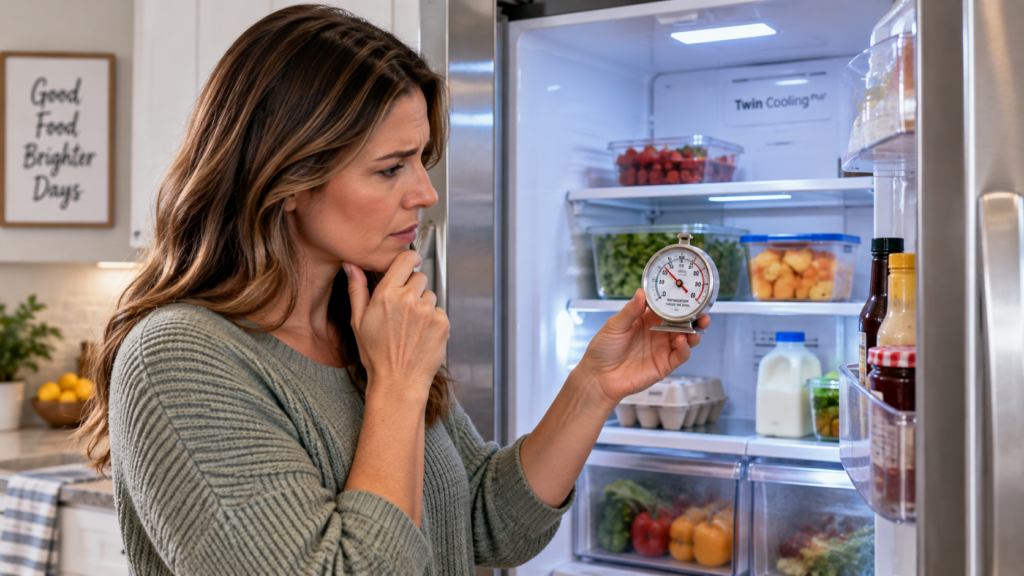
If your refrigerator is not cooling, start with the simple things before assuming the appliance has completely failed.
A refrigerator can stop cooling properly because of an incorrect temperature setting, blocked airflow, dirty condenser coils, a door that isn’t sealing correctly, poor ventilation around the appliance, or a failed internal component.
Some of those problems are easy for a homeowner to identify.
Others require professional appliance repair.
The most important first question is simple:
How warm is the refrigerator actually getting?
How Cold Should a Refrigerator Be?
For food safety, your refrigerator should maintain a temperature of 40°F or below.
An appliance thermometer can give you a much more reliable answer than simply touching a carton of milk and deciding whether it feels cold enough.
USDA food-safety guidance recommends keeping refrigerators at 40°F or below and freezers at 0°F or below.
If your refrigerator is warming above that range, don’t ignore it.
The appliance problem matters—but so does the food inside it.
1. Check the Refrigerator Temperature Setting
Start with the easiest possibility.
Someone may have accidentally changed the temperature control.
This can happen when:
- Groceries bump a control
- Children adjust the settings
- A digital panel is accidentally touched
- The appliance loses power and settings change
- The refrigerator was recently cleaned
Check your owner’s manual for the recommended setting for your particular model.
Many refrigerators perform best somewhere in the upper 30s Fahrenheit, but the important food-safety benchmark is keeping the refrigerator at 40°F or below.
After adjusting the temperature, remember that a refrigerator may need time to stabilize.
Don’t expect the interior temperature to change immediately.
2. Make Sure Air Vents Aren’t Blocked
Cold air has to circulate through the refrigerator.
If food containers, boxes, bags, or other items are packed tightly against interior air vents, cool air may not distribute evenly throughout the compartment.
This can create situations where one part of the refrigerator feels cold while another feels much warmer.
Take a look inside.
Avoid packing food tightly against the back wall or directly in front of visible air vents.
Reorganize items so air can move around them.
This is especially worth checking after:
- A large grocery trip
- A holiday gathering
- Meal preparation
- Loading the refrigerator with large containers
Whirlpool lists overcrowding and blocked airflow among the potential causes of poor refrigerator cooling.
3. Check Whether the Door Is Closing Completely
A refrigerator can’t maintain its temperature if warm room air keeps entering through the door.
Look for anything preventing the door from closing properly.
Common examples include:
- A food container sticking out too far
- An overloaded door shelf
- A drawer that isn’t completely closed
- Packaging caught between the door and cabinet
- A refrigerator that isn’t sitting properly
Close the door and make sure it sits evenly against the cabinet.
If it seems to spring back open or doesn’t close completely, find out what’s obstructing it.
Even a small gap can make the refrigerator work harder while allowing the interior temperature to rise.
4. Inspect the Door Gasket
The flexible seal around the refrigerator door is called the door gasket.
Its job is to create a seal between the door and refrigerator cabinet.
If the gasket is dirty, damaged, loose, or torn, warm air may leak into the refrigerator.
Look around the entire seal.
Check for:
- Cracks
- Tears
- Warping
- Loose sections
- Food residue
- Sticky buildup
If the gasket is simply dirty, clean it according to the refrigerator manufacturer’s instructions.
If it is damaged or no longer sealing properly, replacement may be necessary.
A failed door seal can make the refrigerator run longer while still struggling to maintain temperature.
5. Dirty Condenser Coils May Reduce Cooling
Condenser coils help the refrigerator release heat.
Depending on the model, they may be located:
- Behind the refrigerator
- Underneath the refrigerator
- Behind a lower front grille
- In another manufacturer-specific location
Over time, dust, pet hair, grease, and debris can accumulate around the coils.
Heavy buildup can interfere with the appliance’s ability to release heat efficiently.
Whirlpool specifically identifies dirty condenser coils as one possible reason a refrigerator may not cool properly.
Before cleaning anything, check the owner’s manual for your model.
If the coils are homeowner-accessible and the manufacturer provides cleaning instructions, follow those directions carefully.
Avoid taking panels apart or reaching into areas you aren’t supposed to access.
6. Make Sure the Refrigerator Has Enough Ventilation
Your refrigerator also needs airflow around the outside of the appliance.
It releases heat as part of the cooling process.
If the refrigerator is installed with inadequate clearance around it, heat may not dissipate properly.
Check whether the appliance is:
- Pushed tightly against a wall
- Surrounded by cabinetry without adequate clearance
- Blocked by stored items
- Located in an unusually hot area
The required clearance varies by model.
Your owner’s manual is the best source for the correct spacing.
Whirlpool notes that insufficient clearance around a refrigerator can contribute to cooling problems.
7. An Internal Component May Have Failed
If the basic checks don’t identify the problem, the refrigerator may have a mechanical or electrical failure.
A modern refrigerator contains several components involved in cooling and airflow.
Potential problems can involve items such as:
- Evaporator fan
- Condenser fan
- Compressor
- Temperature sensor
- Thermostat or control
- Defrost system
- Start components
- Electronic control board
This is where homeowner troubleshooting should generally stop.
Simply knowing that a refrigerator isn’t cold doesn’t tell you which component failed.
A qualified appliance technician can test the system and identify the actual cause.
Why Is My Freezer Cold but the Refrigerator Is Warm?
This is a particularly common and confusing symptom.
If the freezer seems cold but the refrigerator compartment is warm, there may be a problem with the way cold air moves from one compartment to the other.
Possible causes can include:
- Blocked air vents
- Ice buildup
- An airflow problem
- A failed fan
- A damper or control problem
- Another internal failure
Start by making sure food isn’t blocking the vents.
If the airflow path appears clear and the refrigerator section remains warm, professional diagnosis may be needed.
Why Is My Refrigerator Running but Not Cooling?
A refrigerator can sound like it’s operating normally while still failing to maintain the correct temperature.
That can happen because the appliance may still have power and certain components may still be operating even though the cooling system isn’t functioning correctly.
If you hear the refrigerator running but the temperature continues climbing, don’t assume that the sound means everything is working properly.
Use an appliance thermometer to verify the actual temperature.
That measurement is more useful than simply listening for the compressor or fans.
Should I Unplug and Restart the Refrigerator?
Some electronic appliances can occasionally benefit from a manufacturer-recommended reset.
But unplugging a refrigerator repeatedly isn’t a substitute for diagnosing a cooling problem.
If your owner’s manual provides a reset procedure, follow the manufacturer’s instructions.
Don’t repeatedly cycle power hoping an underlying mechanical problem will disappear.
And remember that turning the refrigerator off means the interior will begin warming.
Food safety should remain part of the decision.
What Should I Check Before Calling for Refrigerator Repair?
If your refrigerator is not cooling, these are reasonable homeowner-level checks:
Check the temperature setting.
Make sure it hasn’t accidentally changed.
Use a thermometer.
Find out the actual refrigerator temperature.
Check the doors.
Make sure nothing is preventing them from closing.
Inspect the gasket.
Look for obvious damage or debris.
Check interior airflow.
Move food away from vents.
Look at the appliance clearance.
Make sure the refrigerator has the ventilation required by the manufacturer.
Check accessible condenser coils.
Follow your owner’s manual if cleaning is recommended.
Listen for unusual sounds.
Clicking, grinding, buzzing, or changes in normal operation can be useful information for a technician.
You don’t need to diagnose the failed component yourself.
You simply want to eliminate obvious problems and collect useful information.
When Should You Call an Appliance Repair Professional?
Consider professional service if:
- The refrigerator temperature stays above 40°F
- The appliance runs constantly without getting cold
- The freezer is cold but the refrigerator is warm
- You hear repeated clicking or unusual noises
- The refrigerator isn’t running at all
- Ice buildup keeps returning
- The door seal appears damaged
- You smell an electrical or burning odor
- Basic cleaning and airflow checks don’t improve cooling
- The refrigerator suddenly stopped cooling without an obvious explanation
A technician can evaluate internal components that shouldn’t be diagnosed or repaired by an untrained homeowner.
What Should You Do With the Food?
This is one part of refrigerator troubleshooting that shouldn’t be an afterthought.
USDA guidance says refrigerators should maintain food at 40°F or below. Perishable foods that have been above 40°F for more than two hours may need to be discarded.
If the refrigerator has completely lost power, keeping the door closed can help maintain a safe temperature for a limited period. USDA guidance says an unopened refrigerator can generally keep food safely cold for about four hours after power loss.
If cooling failure lasts longer:
- Use an appliance thermometer
- Transfer perishables to a cooler with ice if appropriate
- Minimize door opening
- Don’t rely solely on smell or appearance
- When in doubt about food safety, throw it out
Don’t risk foodborne illness just to avoid wasting groceries.
Can Hot Weather Make a Refrigerator Work Harder?
Yes.
The environment around the refrigerator can influence how hard the appliance has to work.
A refrigerator located in a very hot garage, near an oven, in direct sunlight, or in another unusually warm location may operate differently than one in a climate-controlled kitchen.
Different refrigerator models also have different approved ambient operating ranges.
If your appliance is located in a garage or another area with extreme temperatures, check the owner’s manual to see whether that installation is appropriate for your model.
How Can You Help Your Refrigerator Cool Efficiently?
A few basic habits can help.
Keep the Doors Closed
Every time you open the refrigerator, cold air escapes and warm air enters.
Know what you’re looking for before opening the door rather than standing there deciding what to eat.
Don’t Block Air Vents
Leave room for cold air to circulate inside the refrigerator.
Keep the Door Gasket Clean
Food residue and debris can interfere with the seal.
Follow Coil-Cleaning Instructions
If your refrigerator has homeowner-accessible condenser coils, follow the manufacturer’s recommended maintenance procedure.
Use an Appliance Thermometer
Knowing the actual temperature can help you spot a cooling problem before food begins spoiling.
Does a Home Warranty Cover a Refrigerator That Isn’t Cooling?
Potentially.
A refrigerator that isn’t cooling is a symptom, not a diagnosis.
Whether a repair qualifies for home warranty coverage depends on what failed, why it failed, the homeowner’s specific plan, coverage limits, exclusions, and other contract provisions.
For example, a covered mechanical component failure may be treated differently from maintenance issues, damage, or another condition excluded by the home warranty contract.
SilverBack Home Warranty offers home warranty plan options that may include coverage for certain household appliances.
When a refrigerator claim is filed, professional diagnosis helps answer the important questions:
- What failed?
- Why did it fail?
- What repair is needed?
- Does that failure qualify under the homeowner’s contract?
Always refer to the current SilverBack Home Warranty contract for exact coverage, limits, exclusions, and applicable service call fees.
Frequently Asked Questions About a Refrigerator Not Cooling
Why is my refrigerator not cooling?
Common causes include incorrect temperature settings, blocked interior air vents, a door that isn’t closing correctly, a damaged gasket, dirty condenser coils, inadequate ventilation, or a failed internal component.
Why is my refrigerator running but not getting cold?
The appliance may still have power and some components may be running even though the cooling system isn’t functioning correctly. Check the actual temperature, airflow, condenser area, and door seal. If the temperature remains too warm, schedule professional diagnosis.
Can dirty condenser coils make a refrigerator stop cooling?
Heavy dust and debris on accessible condenser coils can reduce the refrigerator’s ability to release heat and may contribute to poor cooling. Follow the manufacturer-specific cleaning instructions for your model.
Why is my freezer cold but my refrigerator warm?
Cold air may not be moving properly into the refrigerator compartment. Blocked vents, ice buildup, fan problems, or another airflow-related failure may be involved.
What temperature should my refrigerator be?
For food safety, the refrigerator should remain at 40°F or below. Using an appliance thermometer is one of the easiest ways to verify the actual temperature.
How long is food safe if my refrigerator stops cooling?
It depends on the actual food temperature and how long it has been warm. USDA guidance says an unopened refrigerator will generally keep food safely cold for about four hours during a power outage, and perishable foods held above 40°F for more than two hours may need to be discarded.
Does a home warranty cover refrigerator repair?
A home warranty may cover certain refrigerator failures depending on the specific plan, failed component, cause of failure, limits, and exclusions. Diagnosis is usually needed before coverage can be determined.
Refrigerator Not Cooling? Start With the Simple Checks
When your refrigerator is not cooling, don’t immediately assume you need a new appliance.
Start with the basics.
Check the temperature setting.
Make sure the doors close completely.
Clear blocked vents.
Inspect the gasket.
Look at the ventilation around the refrigerator.
Check manufacturer-approved maintenance such as accessible condenser-coil cleaning.
And most importantly, monitor the actual temperature so you can protect the food inside.
If those basic checks don’t solve the problem, a qualified appliance technician can determine what’s happening internally.
For homeowners who want additional protection against unexpected covered appliance and home-system failures, SilverBack Home Warranty offers several home warranty plan options.
SilverBack Home Warranty — We’ve got your back.